

Build data literacy. Grounded, practical, part-time!
Data Science (M.Sc.)
From raw data to smart decisions – AI skills that count on the job from day one.

Free Spots
9
Target group
Working Professionals from all industries, Software & IT specialists (e.g., Developer, Data Engineer) – the largest profile in data/AI roles, Data Analysts, Business Analysts, Controllers, Consultants and product roles & Academics with a Master's or PhD
Deadlines
A limited number of places are still available until October 9, 2026
Program Start: November 23, 2026
Study Fee
16.950 €

Marc Schumilo, Graduate of the Master’s Program
The Data Science program targets exactly the right levers and teaches precisely the skills I now use in practice every day. For me, the program was a direct door opener.
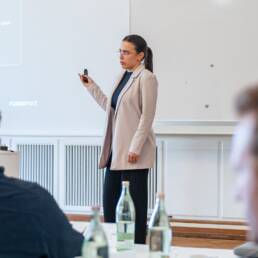
Alexandra Kersten Mota, Student of the Master’s Program
In the second module, for example, we fine-tuned a small ‘GPT-like’ language model for classification tasks – and these are precisely the approaches I’ve gone on to use in my job.

Nina Wagner, Graduate of the Master’s Program
The university sets the right focus on relevant topics so that students are ideally prepared for a career in the field of data science.

Your Masters Degree in Data Science
The part-time Master’s in Data Science equips you with the data literacy to confidently navigate growing data volumes (Big Data) and make data-driven decisions. This interdisciplinary, internationally oriented program builds solid expertise in programming, data analysis, data management, and AI – from machine learning and data engineering to current developments such as large language models (LLMs) and deep learning. Throughout the program, the focus is on practical application in real business scenarios. The Data Science Master’s program is designed for professionals from all industries and fields who want to build their data literacy through hands-on skills – in a targeted, structured way, alongside their job.
Lecture & Modules
The standard period of study for the Master’s program in Data Science is 4 semesters. During this time, you will complete 9 modules, including a project work and the Master’s thesis. An optional preparatory course in e-learning format is also offered. The program is designed for high compatibility with your profession. Modules are typically conducted in blocks of five consecutive days (Monday to Friday). On average, a module takes place every 6 to 12 weeks.
The lectures are held in groups with a maximum of 25 participants, spanning a total of 37 days of in-person attendance. In addition to its interdisciplinary approach, the uniqueness of the program lies in its international collaboration between the University of Münster and the University of Twente, offering courses in English. This part-time education leads to a full Master of Science degree from the University of Münster.
Lecturer & Academic Director


Secure your place today
Find out more about your Master
Contact us for a personal consultation
Find out what qualifications are required
Dates and Facts
Degree
Master of Science
Credit points
90 ECTS
Department
School of Business and Economics
Duration
4 Semesters
Start Date
November 23, 2026, First on-site Module
Application Deadline
September 15, 2026 A limited number of places are still available until October 9, 2026
Language of Instruction
English
Location(s) of Instruction
Münster, Germany | Enschede, Netherlands
Participation Fee
16.950 € in three instalments
- an individual payment plan may be arranged
- exempt from VAT pursuant to § 4 No.21 a (bb) UStG
Target Audience
The Data Science Master’s program is designed for professionals from all industries and fields who want to build their data literacy in a targeted, structured way – regardless of whether they already work in a data-related role or want to develop Data Science as a new area of expertise. This includes professionals from:
- Software development and IT (e.g., Software Engineer, Developer, DevOps Engineer, Data Engineer) who want to move their role toward Data Engineering, MLOps, or Machine Learning – according to current labor market analysis, by far the largest professional profile in data and AI skills²
- Data analysis, statistics, and computer science (e.g., Data Analyst, Data Scientist, BI/Analytics Engineer) who want to deepen and structure their expertise
- Business analytics and controlling (e.g., Controller, Business Analyst), where classic reporting functions are increasingly evolving into data-driven roles
- Consulting (e.g., Consultant), who develop data-based decision-making foundations for clients
- Finance and banking, with growing demand for data analysis and AI-driven processes
- Healthcare, where data analysis increasingly supports diagnostics and process management
- Industry, manufacturing, and engineering (e.g., Cloud Engineer, Site Reliability Engineer), where data literacy is becoming a key qualification for process optimization and quality assurance
- Natural sciences and research, with a growing need for modern data analysis
- Product management and sales (e.g., Product Manager, Product Owner, Key Account Manager, Customer Success Manager), who increasingly use AI tools and data analysis in their daily work
Admission Requierments
- Completion of a first academic degree
- Professional working experience of at least one year
- Evidence of English language proficiency at level B2 (TOEFL, IELTS, etc.)
Free spots
9
Do you want a knowledge update on AI and Data Essentials
Customize your focus by selecting modules from the Data Science master’s program and design your University Certificate.
Further Topics

Digital Information Session
To find out more about the course content, structure and requirements, you can take part in our digital information event on the 1st of September 2026 at 5 pm. Jannis Wegmann will give you some insights into the Master's programme and the Data Science university certificate.

In Cooperation with the University of Twente
"The University of Twente is a smart living lab where talented students and stuff provide groundbreaking research, exiting innovations and inspiring education."
Therefore we are happy to have Twente as a strong educational partner.

Certificate in Data Science
The certificate provides the knowledge and practical skills necessary for data managers to analyze "Big Data". It comprises four modules (2 elective & 2 compulsory) from the English-language, part-time master's program.

We are happy to help you with your questions
Jannis Wegmann
Student advice and support
Mo–Fr: 9.00 am - 4.00 pm


