

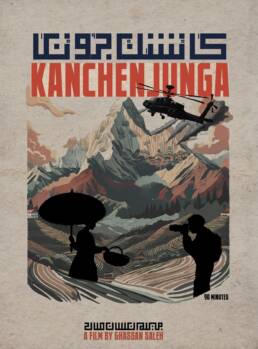
Trailer Graduation Film "Kanchengjunga"
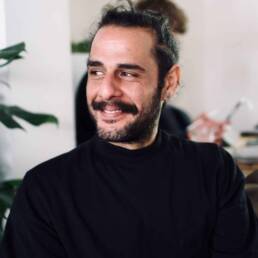
Ghassan Saleh, Graduate
| Name | Ghassan Saleh |
| Country | Lebanon |
| Current Activities | His current work continues to explore image-making, labor, colonial histories, war memory, and the ethics of looking. He is also developing future documentary and photographic projects connected to South Lebanon, migration, personal archives, and everyday forms of survival. |
| Profile |
LinkedIn Film Freeway |
| Master Thesis |
Framing the Unseen: Photography, Power, and the Commodification of Labor and Memory from Darjeeling to Lebanon |
Ghassan Saleh is a filmmaker, photographer, and visual researcher from South Lebanon. He came to images through war, travel, and the need to understand what ordinary language could not hold. During the 2006 war in Lebanon, he first picked up a camera not as a career choice, but as a way to witness, survive, and make sense of a reality that was collapsing around him.
His work moves between documentary cinema, essay film, photography, personal archive, political memory, and visual anthropology. He is drawn to images that appear beautiful at first, but become troubling the longer one looks at them: a landscape marked by violence, a face turned into a symbol, a gesture hiding an entire history of labor, survival, and power. Rather than using cinema to explain the world neatly, his films stay close to uncertainty, contradiction, and the fragile distance between seeing and understanding.
His feature documentary Kanchenjunga (2025) began with a photograph he took in Darjeeling, India: a tea plucker in a blue dress, smiling in the middle of the fields. Years later, unable to forget the image, he returned to Darjeeling to search for her. The journey led him through tea estates, workers’ homes, roads, archives, and 2 conversations, and eventually back to South Lebanon, where his grandmother Kamela once ran a small tea and coffee shop during years of war and occupation. The film is now beginning its festival journey in Germany and internationally. Ghassan’s current and future work continues to explore the politics of images, the memory of places marked by violence, and the strange ways personal stories can reveal global systems. He is interested in collaborations with producers, curators, festivals, artists, and researchers working across documentary cinema, visual anthropology, political
memory, and experimental nonfiction.
About Kanchenjunga
Kanchenjunga is a feature-length hybrid documentary and essay film developed during my MA in Visual Anthropology, Media and Documentary Practices at the University of Münster. The film begins with a photograph I took in Darjeeling, India: a tea plucker in a blue dress, smiling in the middle of the fields. At first, the image seemed beautiful, almost perfect. But later, a simple question changed the way I looked at it: What do I actually know about this woman?
Years later, I returned to Darjeeling to search for her. What began as a personal attempt to find one person slowly became a wider investigation into the hidden structures behind one of the world’s most celebrated teas. Through tea estates, workers’ homes, roads, markets, conversations, photographs, and fragments of memory, the film explores invisible labor, colonial residue, capitalism, gendered work, and the ethics of looking. The journey also leads back to South Lebanon, where my grandmother Kamela once ran a small tea and coffee shop during years of war and occupation. One woman plucked tea. Another poured it. They never met, yet the film connects them through labor, survival, memory, and the invisible routes through which commodities and histories move across the world. Formally, Kanchenjunga is structured as a film within a film. A narrator is invited to read the script, but as he begins to ask questions, the narration starts to break down. The film becomes not only a journey through Darjeeling and South Lebanon, but also a reflection on photography, representation, and the fragile distance between seeing and understanding. The project brings together documentary cinema, visual anthropology, personal archive, travel footage, photography, and essayistic narration. It asks what images reveal, what they hide, and whether looking can ever become a form of responsibility.
Testimonial about the master program
Ghassan chose the V.A. program because it offered a space where filmmaking, anthropology, artistic research, and critical reflection could meet. The program allowed him to question not only what he films, but also how and why he films. Courses and discussions around ethnographic film, representation, fieldwork, and documentary practice helped him develop a more self-reflexive approach to cinema. What he valued most was the possibility to work across disciplines and to treat film not only as a finished product, but as a method of thinking, listening, and encountering others. His current work continues to explore photography, labor, war, travel, memory, and the ethical responsibilities of looking.