Erasmus Study Abroad Experience
Our student Elias spent an Erasmus semester in Ljubljana. For our blog, he has written a personal report about his time in Slovenia’s capital, reflecting on his academic experiences, cultural discoveries, and everyday student life abroad.
On my Erasmus experience in Ljubljana (WS 2024/2025)
II think as anthropology student a lot of us share an interest to put ourselves into socially new situations. For me this was probably a big part of the motivation for the Erasmus. Before going on Erasmus, I did not know a lot about Ljubljana and Slovenia in general. I have heard some stories here and there and a Serbian friend (David) just moved there shortly before I decided to do my Erasmus. Since I grew up in Münster and now live in Freiburg since almost a decade and I was curious on trying changes: Meeting new people, adapting to a new city and making new friends. And of course, there was also the subject-related curiosity towards other department´s approaches to (visual) anthropology.
Experiencing Ljubljana
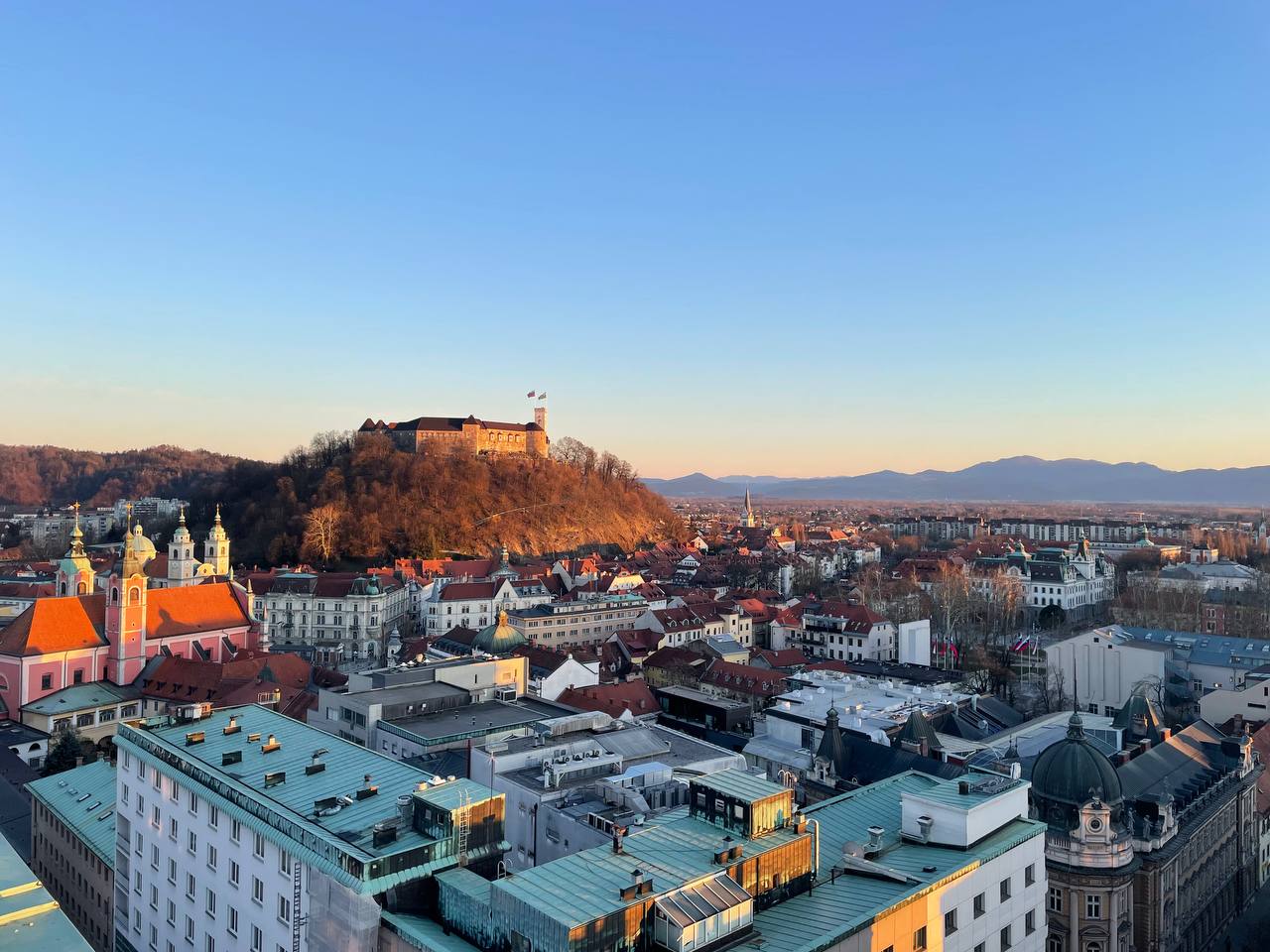
Arriving in Ljubljana was very welcoming. David introduced me to his friends, and they helped me arranging a room in a shared flat for me to stay. In this sense I was very lucky because the housing situation in Ljubljana is very difficult and I can really recommend starting as early as possible with the process of searching. In my case, I was happy to live with other young people in a shared flat and most of them were Ljubljana locals and willing to share their local knowledge and show me around. I really enjoyed the city of Ljubljana and think in several aspects it can be considered a good Erasmus-city: It is a bit smaller then Münster which makes it approachable and you run into someone you know from a seminar when you walk around the city. At the same time, you can tell that is a capital city through its cultural offer: You have the chance of going to good concerts or interesting exhibitions. Aside a little highlight is that you can see the alps at the horizon of the city on a day of clear sky What I find a bit sad is that I chose the winter semester for my stay and just when I was about to leave the city started to flourish and people started to sit outside in the evenings.
The department & Erasmus coordination
I experienced, the Erasmus coordination in Ljubljana as very well structured. There were welcoming-events, websites, hotlines (with actual people) and the Anthropological
Department´s Erasmus coordinator Sarah Lunacek Brumen was very helpful. The department also made sure that there were mixed classes in English that Erasmus- and local-students attended together. In one class we conducted a group research about housing in Ljubljana together with local students and by this I felt like diving more deeply into the bubble of the local anthropology students. The group of Erasmus anthropologists was also very connected: We went to bars, events, had meals together or gossiped about teachers (typical student things).
A highlight for us students was the “Boni”-system. The university arranged for local and Erasmus students a system that we had food discounts in a lot of local restaurants. In some restaurants we could get a slice of pizza for free, in others a proper meal for 4 euro. This invited us students to explore the food diversity in the city between or after classes.
Academic comparison
In summary it was obvious, that the master in Münster is way more focused on visual anthropology. In my Erasmus stay I only had chance to take one explicit V.A.-class (taught by Sarah). But I liked that it happened to be in a very small group and by this I could really get into deep exchange with Sarah about my video project. Aside I could choose between anthropology classes about `current anthropological trends´, ´Everyday life´ or complexities of modernity which was also very interesting. Further, the Erasmus also gave me the chance to take a very interesting class in philosophy. Another advice I have for V.A. students that go to Ljubljana is to match the stay with the D.E.F.-Festival (Days of Ethnographic Film: DEF | DEF – Ethnographic film festival). I was lucky to be able to attend and work with the festival just at the end of my Erasmus stay. The festival organisation was a very friendly team and participating gave me the chance to meet a lot of interesting people and watch a lot of interesting films. Thanks for that!
I think the biggest difference to the master in Münster was the semester-structure. The Erasmus gave me a chance to study in a less compressed way. Instead, I could work on my V.A. project step by step and have regular exchange about the projects with my classmates. By this, I can recommend attending an Erasmus because it brings a little balance to the part-time-structure of the Master’s program in terms of social aspects and the academic structure.